ANSI 107 Types R, O, and P: The Hi-Vis Spec Most Buyers Miss
Most people shopping for hi-vis vests learn one number, the Class, and stop there. Class 2 for the road crew, Class 3 for the night shift, done. But ANSI/ISEA 107, the standard that governs high-visibility apparel in the United States, actually asks two questions, not one. Class is the second. The first is Type, and it is the spec that quietly decides whether a vest is even eligible for the work your crew does. Order the wrong Type and a technically compliant Class 2 vest can still be the wrong garment for the job. Here is how the two settings work together.
Two dials, not one
Think of Type and Class as separate dials on the same standard. Type answers where and by whom the garment is worn: the work environment and the wearer’s role. Class answers how much visible material the garment carries: the total area of fluorescent background fabric and retroreflective tape. You set both. A vest is described as, for example, Type R Class 2, and each half of that label is doing a different job. Getting Class right without getting Type right is only half a decision.
The three Types: O, R, and P
ANSI/ISEA 107-2020 defines three garment Types. Type O, for Off-Road, is built for controlled environments that are not exposed to public vehicle traffic, such as warehouses, distribution yards, factory floors, and some oil and gas sites. Type O exists in a single Performance Class, Class 1, because the hazard it addresses is lower speed and lower proximity to traffic than a highway.
Type R, for Roadway, is the workhorse for anyone exposed to public roadway traffic or temporary traffic control zones: road construction, utility work in the right-of-way, flagging, and transportation crews. Type R garments carry more background and retroreflective material and are offered in Class 2 and Class 3. Type P, for Public Safety, covers the same roadway visibility need for police, fire, and EMS but in a garment often cut shorter or designed for quick access to duty belts and equipment. Type P is also offered in Class 2 and Class 3. The Type you pick follows the environment; the differences between them exist because a warehouse and a 60-mph shoulder are not the same hazard.
What Class actually measures
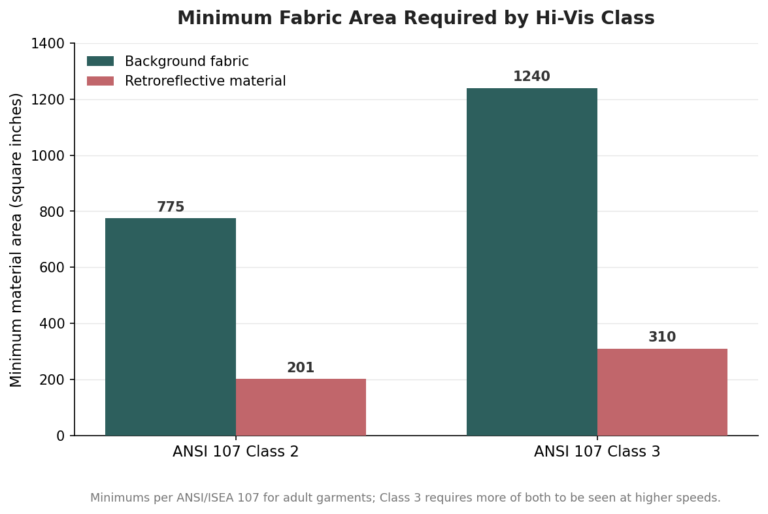
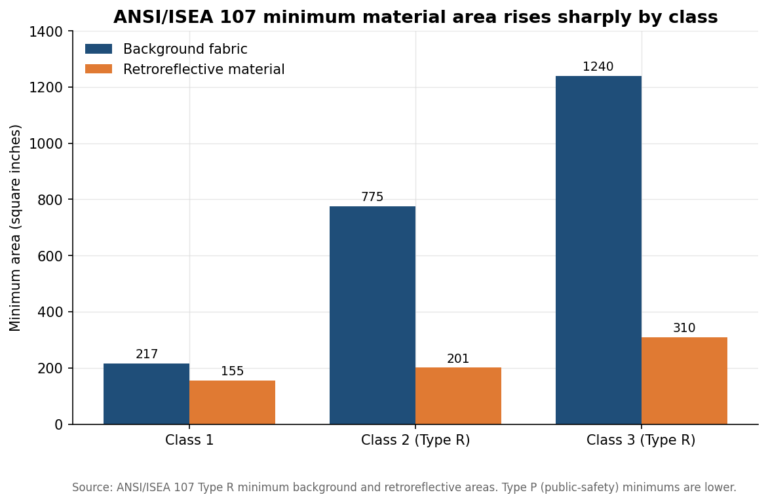
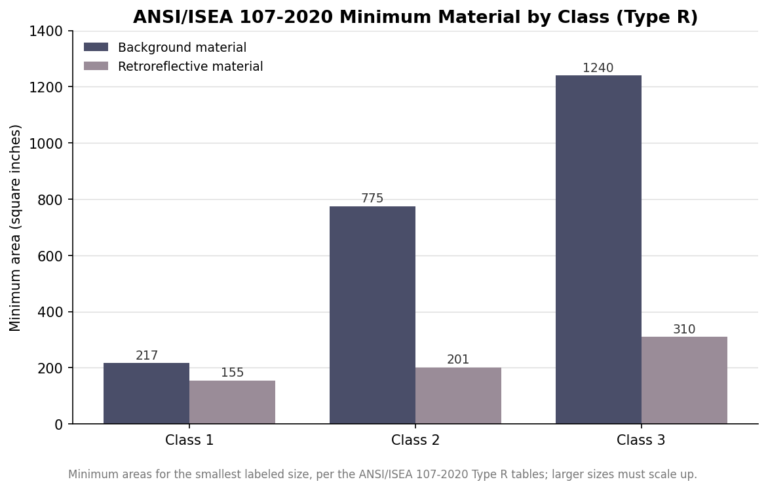
Class is where the standard gets concrete. Each Performance Class sets a minimum area of fluorescent background material and a minimum area of retroreflective material, and those minimums climb steeply as the Class rises. The chart below shows the required areas in square inches. The jump from Class 1 to Class 2 is large on the background fabric in particular, which is why a Class 2 vest looks and feels substantially more covered than a minimal Class 1.
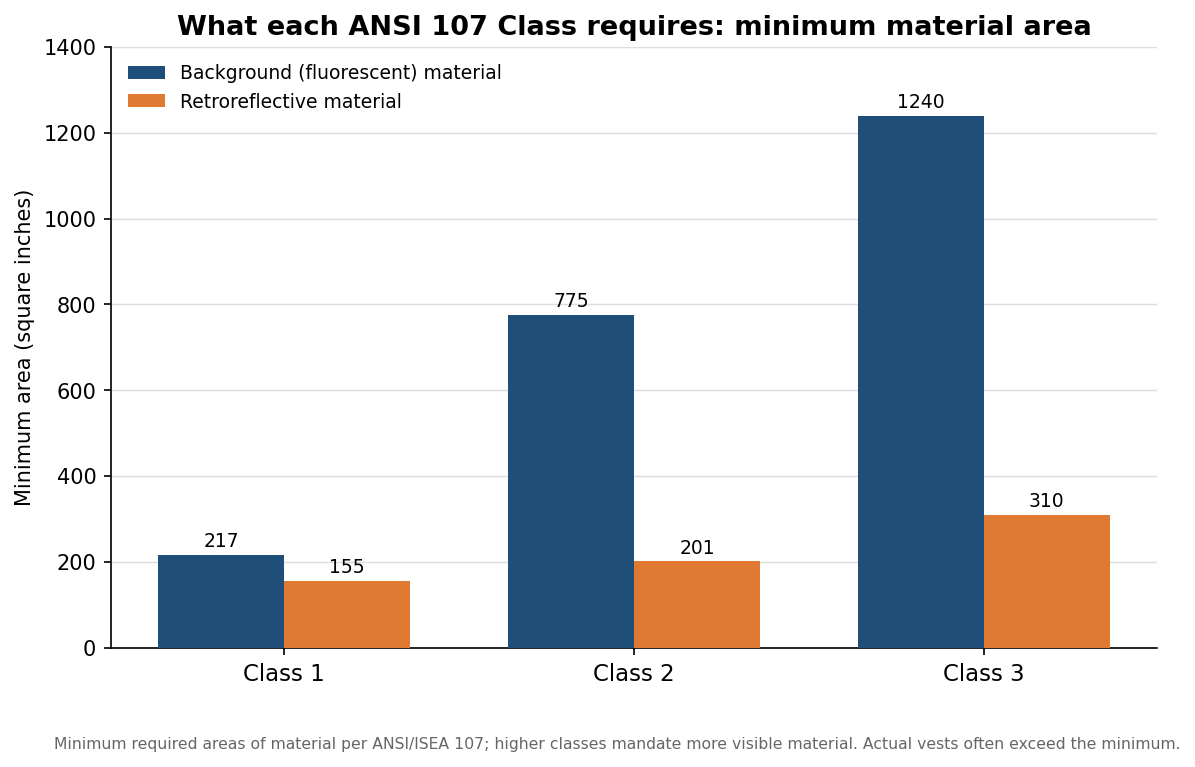
These are minimums, not targets. A given vest, especially a roomier size, often carries more material than the floor for its Class, and design choices like sleeves or added tape push coverage higher. The takeaway for a buyer is that Class is a measurable, auditable property: a Class 3 garment must carry at least 1,240 square inches of background material and 310 of retroreflective material, and no amount of branding or styling changes that requirement.
Which combinations actually exist
Because Type and Class are linked, not every pairing is available, and this trips up buyers who assume they can order any Class in any Type. Type O comes only in Class 1. Type R and Type P each come in Class 2 or Class 3. There is no Type O Class 2, and no Class 1 roadway garment. The matrix below lays out the valid combinations at a glance so you can confirm the label you are about to order is a real, certifiable configuration.
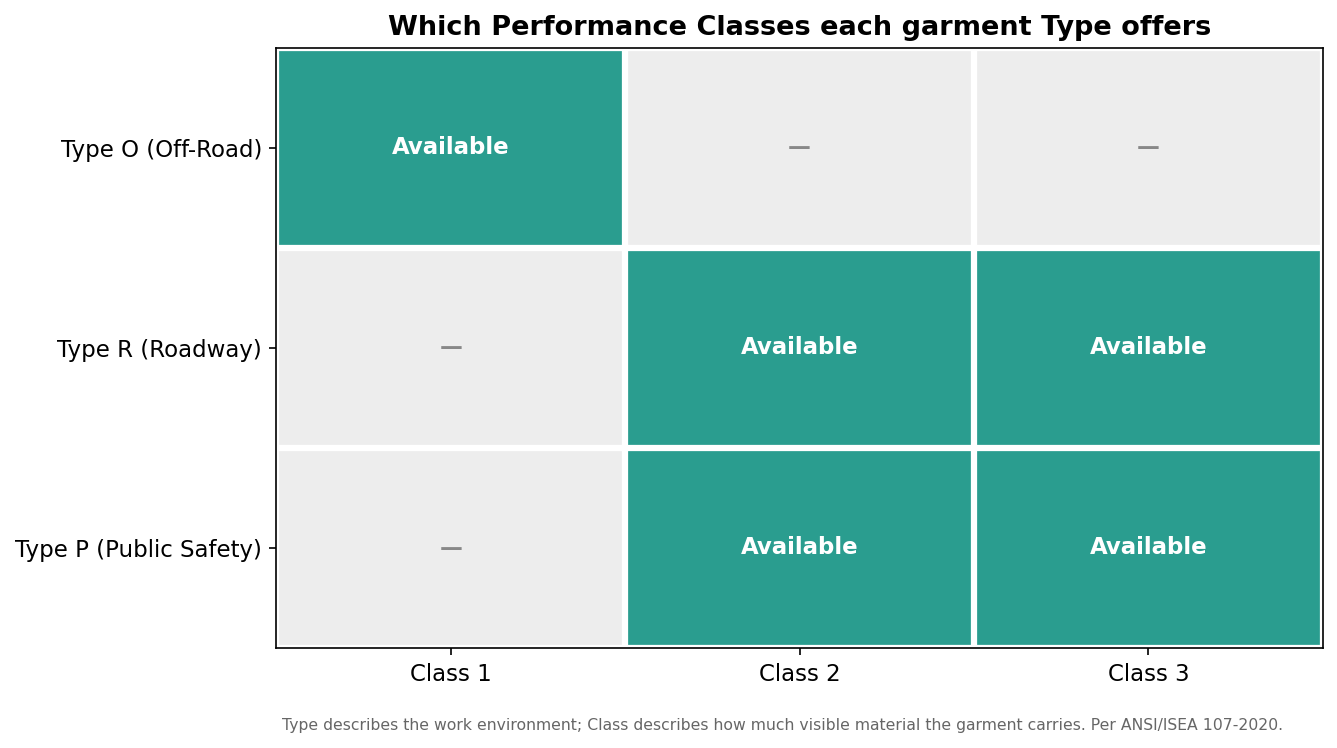
When you are speccing a custom run, this matrix is the first sanity check. If a supplier quote lists a combination that is not on the grid, something is mislabeled, and a mislabeled garment is a compliance problem waiting to surface during an audit or an incident review.
The rule that often makes the choice for you
For a large share of buyers, the decision is not entirely open, because federal regulation sets a floor. Under the Federal Highway Administration’s worker visibility rule at 23 CFR Part 634, workers on foot within the right-of-way of a federal-aid highway must wear high-visibility safety apparel meeting ANSI/ISEA 107 Performance Class 2 or Class 3. In practice that pushes roadway and highway work zones to Type R Class 2 at minimum, with Class 3 common for higher speeds, lower light, or complex backgrounds. Many states and agencies layer their own requirements on top, and site safety plans frequently specify Class 3 outright.
So the practical path is to start with the environment, which sets your Type, then apply the governing rule and your own risk assessment to land on the Class. A warehouse team indoors is a Type O Class 1 candidate. A crew in a live highway work zone is Type R, Class 2 or 3 depending on speed, light, and agency rules. First responders directing traffic at a scene are Type P. Decide Type and Class in that order, confirm the pairing is valid, and then move on to the fit, features, and branding, knowing the vest underneath the logo is the right garment for the hazard.
One last practical note for anyone buying a mixed fleet: a single crew can legitimately need more than one label. The office staff who occasionally cross the yard may be fine in Type O Class 1, while the same employer’s field crew in the roadway needs Type R Class 2 or 3. Rather than forcing one vest on everyone, map each role to its environment first, then order to that map. It is cheaper and safer than discovering at an audit that half the fleet is under-rated for where it actually works.