H1
Mesh vs. Solid Tricot vs. FR Modacrylic: A Hi-Vis Vest Material Engineering Guide
Intro
The shell material of a hi-vis vest determines almost everything about how it performs in service: how hot it is at hour 8 of a shift, how many wash cycles it survives before background color drops below ANSI 107 chromaticity, how cleanly a screen-print holds up, whether it’s appropriate for arc-flash or ignition-zone work, and what it costs per vest at your volume. Most buyers default to mesh because that’s what they’ve seen before, but the right material depends on your crew’s actual exposure profile. This guide compares the three main shell materials used in ANSI 107-compliant hi-vis vests, with real test data where we have it.
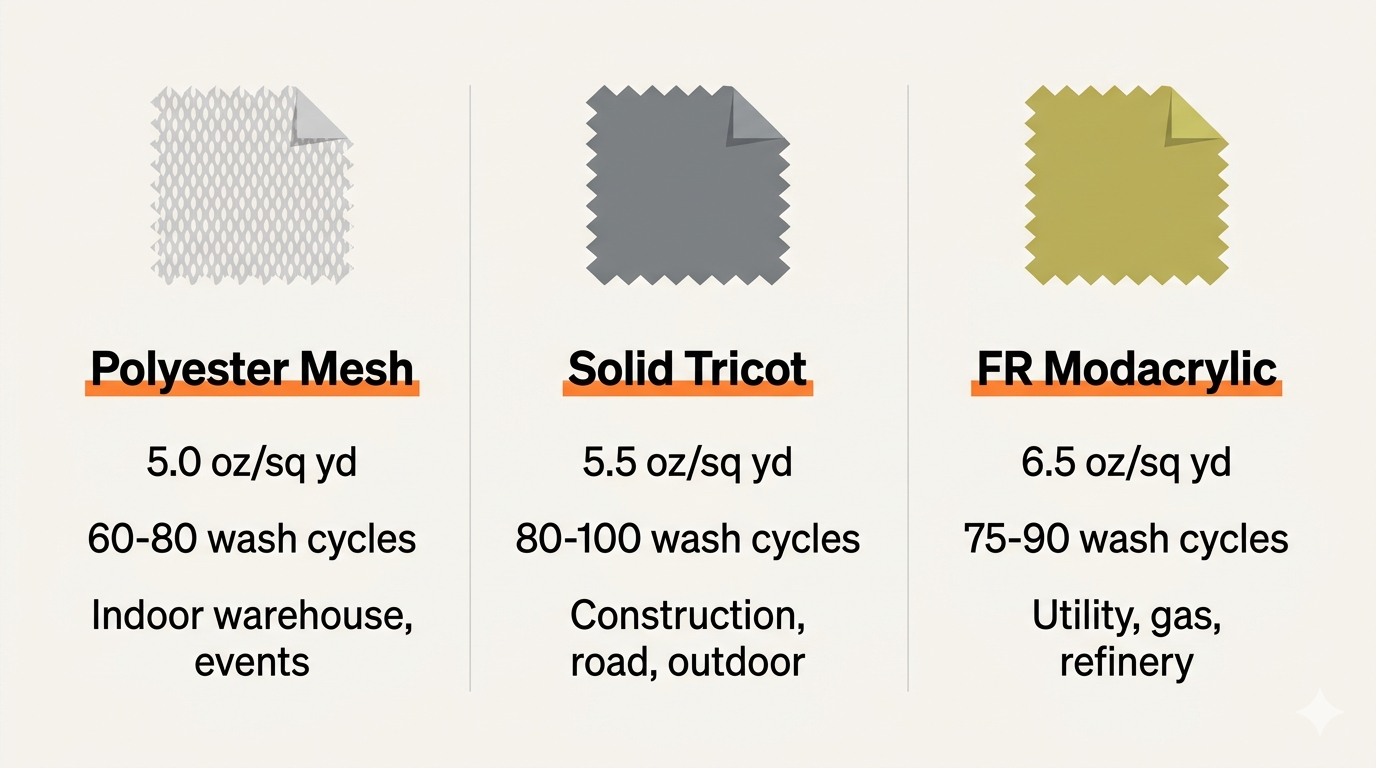
The three materials at a glance
| Material | Weight | Best for | Typical service life | Relative cost |
|---|---|---|---|---|
| Polyester mesh | 5.0 oz/sq yd | Indoor warehouse, events, hot environments | 60–80 industrial wash cycles | Lowest |
| Polyester solid tricot | 5.5 oz/sq yd | Construction, road, outdoor mixed conditions | 80–100 industrial wash cycles | Middle |
| FR modacrylic blend | 6.5 oz/sq yd | Electric utility, gas, oil & gas, refinery | 75–90 industrial wash cycles (FR-specific wash) | Highest |
Numbers reflect typical performance from independent textile testing labs and from manufacturer specifications. Your mileage varies with wash chemistry, sun exposure, and abrasion exposure.
Polyester mesh
Mesh is an open-weave knit polyester. The defining structural property is that it’s not a closed weave — there are visible interstitial gaps in the fabric. This gives mesh its key advantage and its key disadvantage in one trait.
Advantage: airflow. A mesh vest at 90°F in still air is meaningfully cooler than a tricot vest. The difference is most pronounced when a worker is doing sustained physical work — repeated bending, reaching, climbing — where body heat dissipation is the limiting factor. In our customer surveys, mesh vests are correlated with lower complaint rates in warehouse, summer event, and crowd-management deployments.
Disadvantage: snag and abrasion. The open weave snags on sharp edges, rebar, and rough surfaces. Mesh is the wrong choice for construction crews handling rebar, demolition, or any environment with regular contact against rough materials. We’ve seen mesh vests fail in under 30 days of construction service from snag damage alone.
Wash durability. Mesh holds up well in industrial wash because there’s less fabric to stress per wash cycle, but the weave structure does loosen over time. We typically see 60–80 wash cycles before mesh shows visible weave degradation. Fluorescent background color holds within ANSI chromaticity spec for that range.
Decoration compatibility. Screen print on mesh is tricky — the ink can flash through the weave gaps onto the underlying garment or onto the press platen. Most mesh decoration uses heat transfer (vinyl applied at heat and pressure) rather than screen print. Heat transfer holds up well on mesh through 50+ wash cycles when applied at the right temperature and pressure.
When to spec mesh. Indoor warehouse, distribution center, food service, event marshaling, hospitality, indoor security, summer outdoor events.
Polyester solid tricot
Tricot is a closed-weave knit polyester. The weave is tighter, the fabric is heavier per square yard, and the surface is uniform.
Advantage: durability and decoration quality. Tricot survives abrasion better than mesh. It holds screen print and heat transfer with sharper edges and more vibrant color reproduction. Tricot is the right material for crews doing real physical work in dirty environments.
Advantage: continuous background area. Because tricot is a solid weave, the entire vest surface counts as fluorescent background area. This matters for Class 3 compliance, where the 1240 sq inch background minimum is easier to hit on tricot than on mesh.
Disadvantage: heat retention. Tricot is hotter than mesh in still-air conditions. Workers in 90°F+ warehouse environments will notice the difference. Construction crews in summer humidity will too.
Wash durability. Tricot survives 80–100 industrial wash cycles in typical conditions. The failure mode is usually fluorescent color fade (the dye system gradually washes out) rather than structural failure of the fabric.
Decoration compatibility. Tricot is the gold-standard surface for screen print and heat transfer. Single-color screen print on tricot can survive 100+ wash cycles with proper plastisol ink and cure. Multi-color heat transfer holds through 50–75 wash cycles depending on the vinyl chemistry.
When to spec tricot. Construction, road and highway, outdoor utility, fleet vehicle operations, traffic control, parking enforcement, any crew where decoration quality and longevity matter.
FR modacrylic blend
Modacrylic is a modified-acrylic fiber that doesn’t melt under flame exposure — it chars instead. Hi-vis FR shells are typically a modacrylic-polyester-cotton blend engineered to maintain ANSI 107 background chromaticity while meeting ASTM F1506 arc-thermal performance specifications.
Advantage: arc-flash and ignition compatibility. The whole point of FR is that the vest doesn’t ignite, melt, or accelerate burn when exposed to arc-flash or open flame. For electric utility linemen, gas distribution crews, oil-and-gas service crews, refinery workers, and any worker in a potential ignition zone, FR is not optional — non-FR polyester can ignite or melt and stick to skin during an incident.
ATPV ratings. ASTM F1506 requires an Arc-Thermal Performance Value (ATPV). Common ratings: 8 cal/cm² for general distribution work, 12 cal/cm² for substation switching, 25+ cal/cm² for high-incident-energy environments. The ATPV is a function of fabric weight and blend chemistry — heavier fabrics and higher modacrylic content give higher ATPV.
Disadvantage: cost. FR shells cost roughly 2x more per square yard than standard polyester. A finished FR vest typically prices 60–100% above an equivalent standard polyester vest at the same quantity tier.
Disadvantage: weight and heat. FR modacrylic blends are heavier (6.5 oz/sq yd vs 5.5 for standard polyester tricot) and retain more heat. Summer outdoor work in FR is uncomfortable; many FR-required crews use lightweight FR base layers under the FR hi-vis vest as the heat-management strategy.
Wash durability. FR vests must be washed in FR-compatible detergent and laundry conditions. Bleach, fabric softener, and standard industrial detergents can degrade the FR performance over time. Most utilities specify a contract laundry service for FR PPE. With proper wash, FR shells survive 75–90 wash cycles.
Decoration compatibility. Tricky. Standard plastisol screen-print inks and standard heat-transfer vinyl can compromise the FR rating. Reputable FR vest manufacturers use FR-compatible inks and FR-rated heat-transfer materials specifically engineered for FR substrates. If your vendor can’t confirm the decoration materials are FR-compatible, the vest’s FR certification doesn’t carry over to the decorated garment.
When to spec FR. Electric utility lineworkers, gas distribution, oil-and-gas service, refinery workers, hot-work zone construction, welding-adjacent operations.
Decoration-method compatibility
A quick reference for what works on what:
| Material | Screen print | Heat transfer | Sublimation | Embroidery |
|---|---|---|---|---|
| Polyester mesh | Difficult (ink flashes through) | Best | Possible but limited | Possible |
| Polyester tricot | Best | Excellent | Excellent | Excellent |
| FR modacrylic | Only with FR-rated inks | Only with FR-rated vinyl | Limited; verify FR compatibility | Best (with FR thread) |
For high-volume single-color logos, screen print on tricot is the cost-efficient default. For multi-color logos or photographic art, heat transfer on tricot. For FR vests, use the FR-rated material chain end-to-end.
Cost comparison at typical volumes
Approximate per-vest cost ranges by material at common quantity tiers (relative figures — your quote will be specific to your spec):
| Quantity | Mesh, Class 2 | Tricot, Class 2 | Tricot, Class 3 | FR Tricot, Class 2 |
|---|---|---|---|---|
| 100 vests | Baseline | +12–18% | +25–35% | +90–120% |
| 500 vests | Baseline | +10–15% | +22–30% | +75–100% |
| 2,500 vests | Baseline | +8–12% | +18–25% | +65–85% |
| 10,000 vests | Baseline | +6–10% | +15–22% | +55–75% |
Volume compresses the cost gap between materials. At 10,000+ vests, the per-vest premium for FR drops meaningfully but never approaches non-FR cost because the modacrylic blend itself is structurally more expensive.
The decision framework
A simple sequence to choose material:
- Is the work in an arc-flash or ignition zone? Yes → FR modacrylic. No → continue.
- Is the work primarily indoor with no rough-material contact? Yes → mesh. No → continue.
- Is the work outdoor or involves abrasion-exposure environments? Yes → tricot. No → mesh.
- Is Class 3 background area required? Yes → tricot makes the 1240 sq in easier. No → either works.
- Will the vest be screen-printed or have multi-color decoration? Yes → tricot is the better substrate.
For most customers, the answer comes out as: mesh for warehouse, tricot for outdoor/construction/road, FR tricot for energy. The exceptions are explicit (cold-chain freezer ops, summer event marshaling, indoor utility work) and worth discussing with a vendor who’ll engineer the right spec rather than just default to mesh.
Bottom line
Material choice is one of the three biggest cost-and-performance levers in a hi-vis vest order (the others being class and decoration complexity). Mesh for indoor and hot environments, tricot for outdoor durability and decoration quality, FR for any ignition-zone work. Don’t let a vendor default everyone to one material — the right choice depends on the actual work.
CTA: Tell us your crew’s exposure profile and we’ll spec the right material. Free mockup in 24–48 hours. → /get-a-custom-quote
Win Free Stuff
Enter below for a chance to win plus receive 10% off your first order.
🎉 You are in!
Check your email for your 10% off code. Good luck!