When Is a Hi-Vis Vest Legally Required? OSHA, the Federal Highway Rule, and ANSI Classes
The honest answer to “is a hi-vis vest legally required?” is that there is no single blanket law that covers every worker. The requirement comes from a few overlapping sources, and which one applies depends on where the work happens and who is doing it. For anyone buying vests for a crew, it is worth understanding those sources, because they also dictate the ANSI class you need to order rather than just the color you prefer.
OSHA has no hi-vis standard, but the General Duty Clause still applies
People often assume there is an OSHA rule that says “wear a vest,” and there is not a specific high-visibility apparel standard in the general industry rules. What OSHA has instead is the General Duty Clause, Section 5(a)(1) of the Occupational Safety and Health Act, which requires employers to keep a workplace free of recognized hazards likely to cause serious harm. Where being struck by a vehicle or by mobile equipment is a recognized hazard, OSHA can and does cite employers whose workers are not made visible. In practice that means a supervisor cannot point to the absence of a named vest rule as a reason to skip hi-vis; if a reasonable person would see a struck-by risk, the apparel is effectively expected. OSHA also frequently leans on consensus standards and the traffic-control manual described below to define what “adequately visible” looks like.
The federal highway rule is the clearest mandate
The most concrete requirement is the Worker Visibility rule, found at 23 CFR Part 634, which took effect no later than November 24, 2008. It requires that workers on foot within the right-of-way of a Federal-aid highway, when exposed to traffic or to construction equipment, wear high-visibility apparel meeting the Performance Class 2 or Class 3 requirements of ANSI/ISEA 107, with Class 2 as the floor. The rule reaches a wide set of people: construction and maintenance crews, survey teams, utility workers, and emergency responders. Law enforcement officers are covered when they are directing traffic, investigating crashes, or handling lane closures and similar incidents, and firefighters are exempt only while actively fighting a fire, needing to comply during other roadway activities. The important limit is scope: as written, the rule applies to Federal-aid highways rather than to every street, so a parking lot or a private site is governed by the general-duty logic above rather than by this specific rule. The Manual on Uniform Traffic Control Devices reinforces the same Class 2-or-3 expectation inside work zones.
What “Class 2 or 3” actually requires
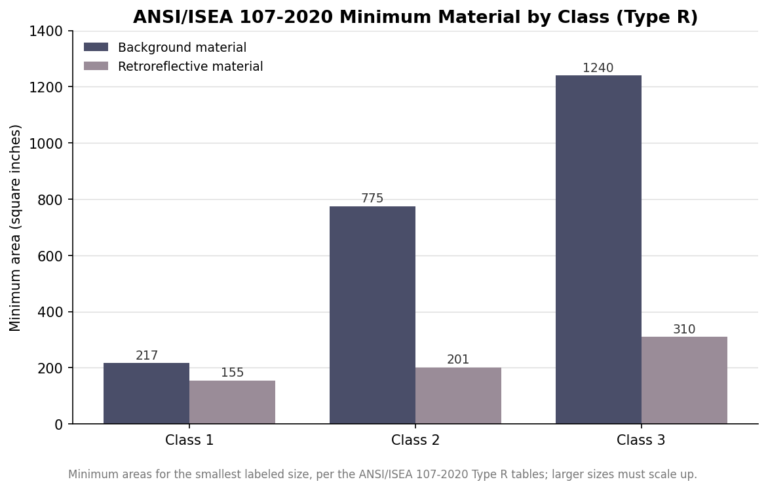
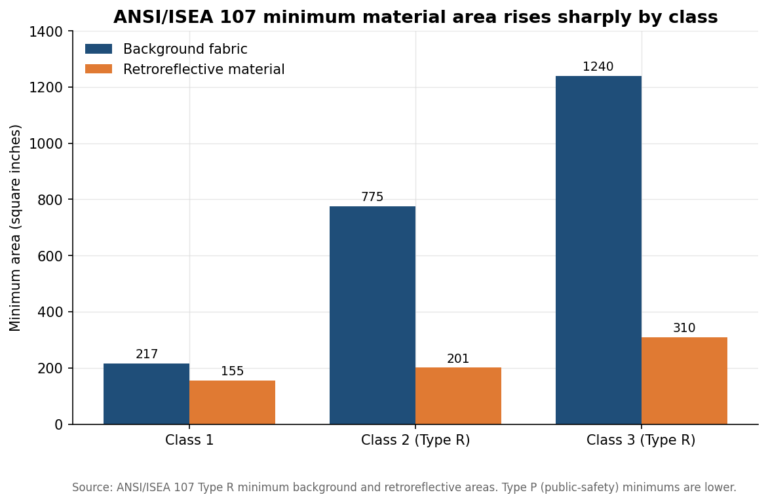
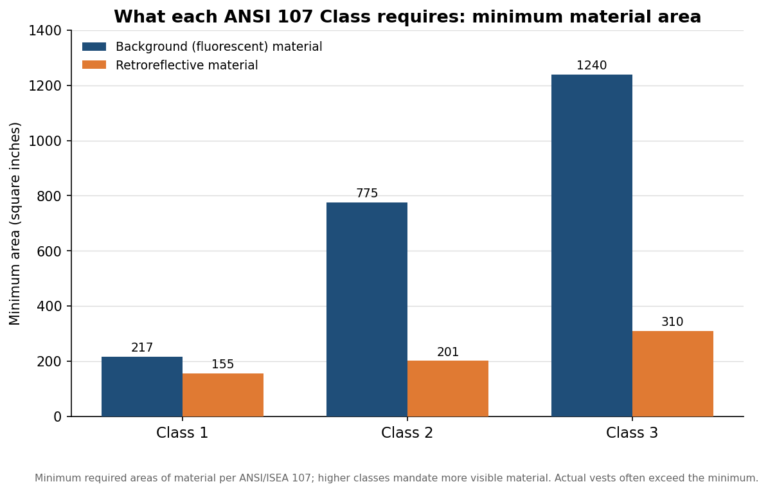
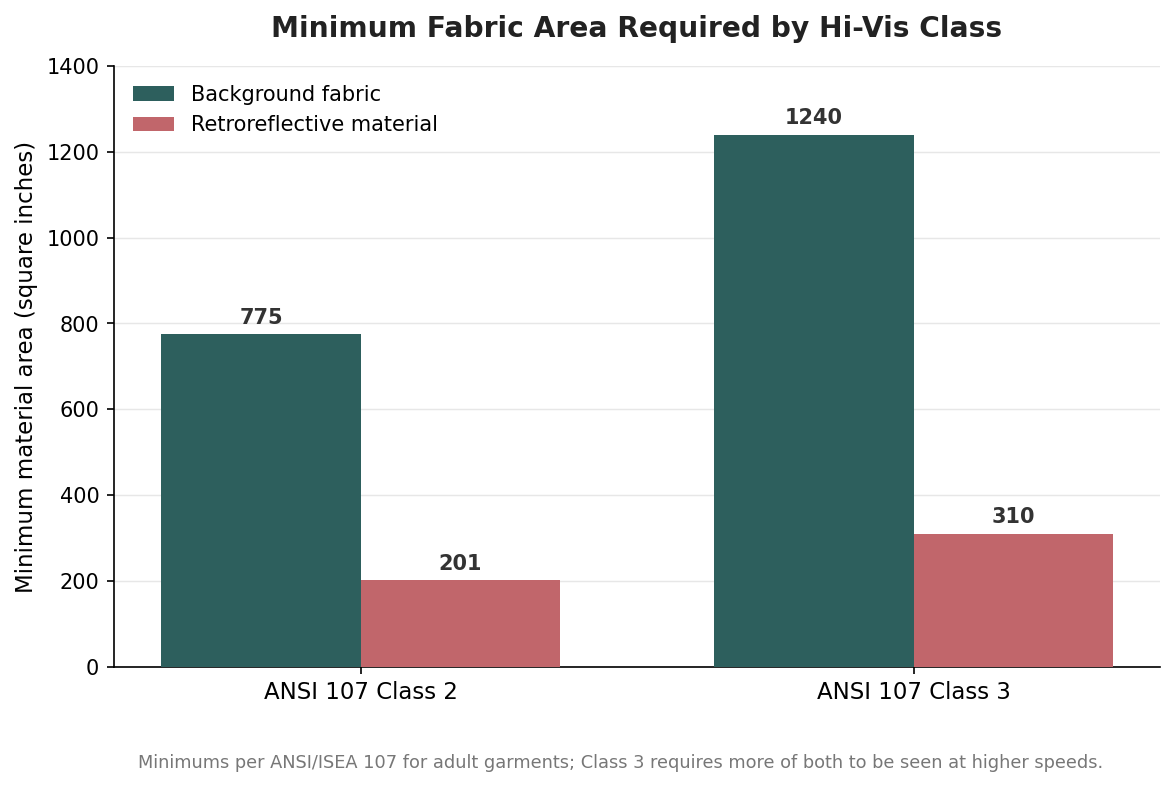
ANSI/ISEA 107 is the consensus standard those rules point to, and its classes are defined by how much visible material a garment carries, not by brand or by looks. A Class 2 garment must have at least 775 square inches of background fabric and 201 square inches of retroreflective material, while a Class 3 garment steps up to at least 1,240 square inches of background and 310 square inches of retroreflective material. That extra area is why a Class 3 garment usually has sleeves or added bands rather than just being a brighter vest. The standard also assigns a Type to the garment: Type R for roadway and temporary traffic control settings, Type O for off-road environments without traffic exposure, and Type P for public safety responders who need gear access. When a spec sheet says “Type R, Class 2,” both halves are doing work, and both are what a compliance officer will check.
Matching the class to the job
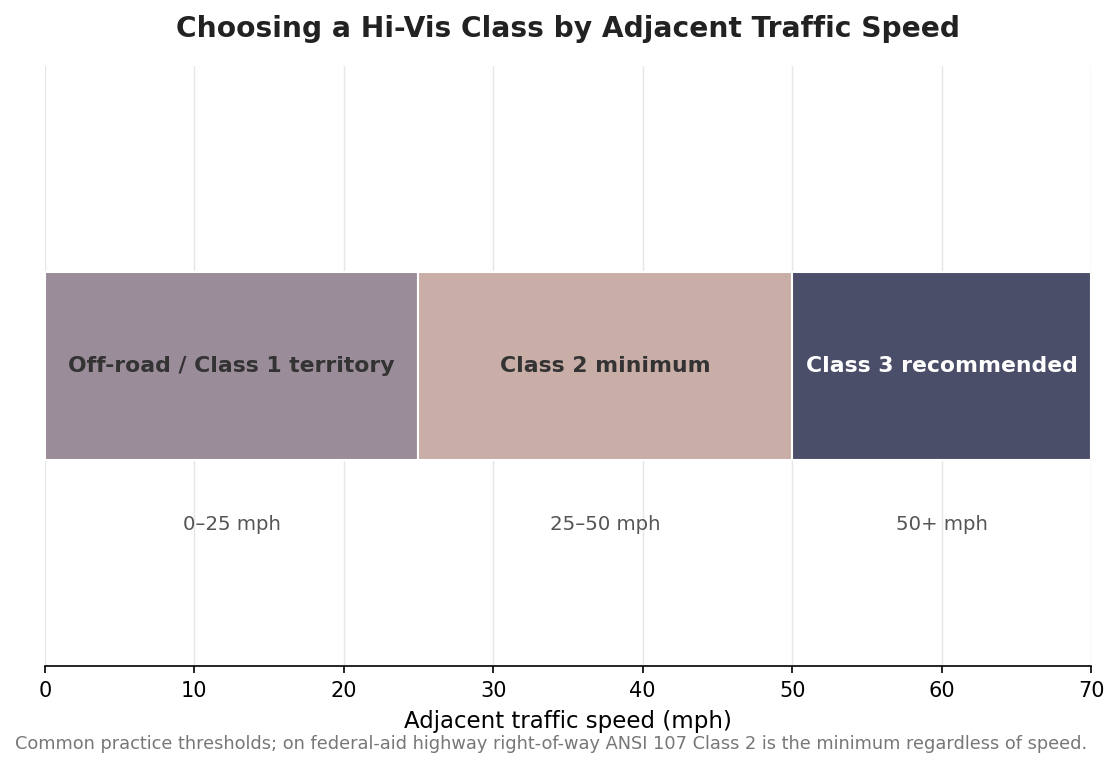
Choosing between Class 2 and Class 3 usually comes down to the speed and complexity of the traffic near the worker. A common rule of thumb puts Class 2 with traffic moving faster than about 25 mph and Class 3 where speeds exceed roughly 50 mph or where sight lines are poor, at night, or in weather. These speed thresholds are practical guidance rather than a single national statute, and they can be overridden by the governing rule for a given site. On a Federal-aid highway, for instance, Class 2 is the minimum regardless of the posted speed, and many agencies specify Class 3 for nighttime work as a matter of policy. It also helps to think about the background against which a worker will be seen: a lime-yellow garment can wash out against spring foliage or a green-painted machine, while orange can disappear against autumn leaves or brick, so crews that move between settings sometimes standardize on the class first and then pick the color that contrasts best with their usual surroundings. The band below is a starting point for the conversation, not a substitute for the specification your project or agency hands you.
Public safety, state plans, and confirming your own requirement
Two wrinkles are worth knowing before you order. First, first responders have a companion standard, ANSI/ISEA 207, written for public safety vests that are shorter and allow quick access to a duty belt and equipment, often with breakaway features; a police or fire buyer may be pointed to 207 rather than to a standard 107 vest. Second, roughly half the states run their own OSHA-approved plans, and some industries and agencies layer on stricter apparel rules than the federal floor, so the requirement that binds your crew may be more demanding than the national baseline. Because of that, treat everything here as a factual overview of the regulatory landscape rather than legal advice for your specific site. Before a bulk order, confirm the class, type, and any color or logo-placement rules with the authority that governs your work, whether that is a state OSHA office, a department of transportation project specification, or your own safety manager, and keep the garment’s compliance label so an inspector can verify it in the field.