H1
ANSI 107 Class 2 vs. Class 3: A Buying Guide for Crew Supervisors
Intro
If you supervise a crew that needs hi-vis vests and your safety team has handed you “ANSI 107 compliant” as the spec, you’re not done. ANSI/ISEA 107-2020 defines three garment performance classes — Class 1, 2, and 3 — and the wrong choice costs you either money (over-spec for the work) or compliance (under-spec for the traffic exposure). This guide walks through the actual standard, the speed and visibility thresholds that drive the decision, and a decision framework you can apply to your specific crew.
The standard, in plain language
ANSI/ISEA 107-2020 is the American National Standard for High-Visibility Safety Apparel. It’s published by the International Safety Equipment Association and adopted by reference into OSHA enforcement, MUTCD traffic-control standards, and most state DOT specifications. The standard defines three garment classes plus a “Performance Class E” for pants and accessories.
Two technical metrics drive the class assignment: the minimum area of fluorescent background material (measured in square inches) and the configuration and area of retroreflective tape. Higher class = more background, more tape, more coverage angles.
The standard also specifies acceptable background colors (fluorescent yellow-green, fluorescent orange-red, fluorescent red), photometric performance requirements for the retroreflective tape (>330 candela per lux at standard observation angles), and durability requirements after wash cycles.
A vest that meets the standard at sale must continue to meet it through its service life. That’s why background area calculations matter — a logo that covers too much background can drop a Class 2 vest below the minimum required area, which technically disqualifies it from compliance even though the labels still read “Class 2.”
Class 2: The 775-inch standard
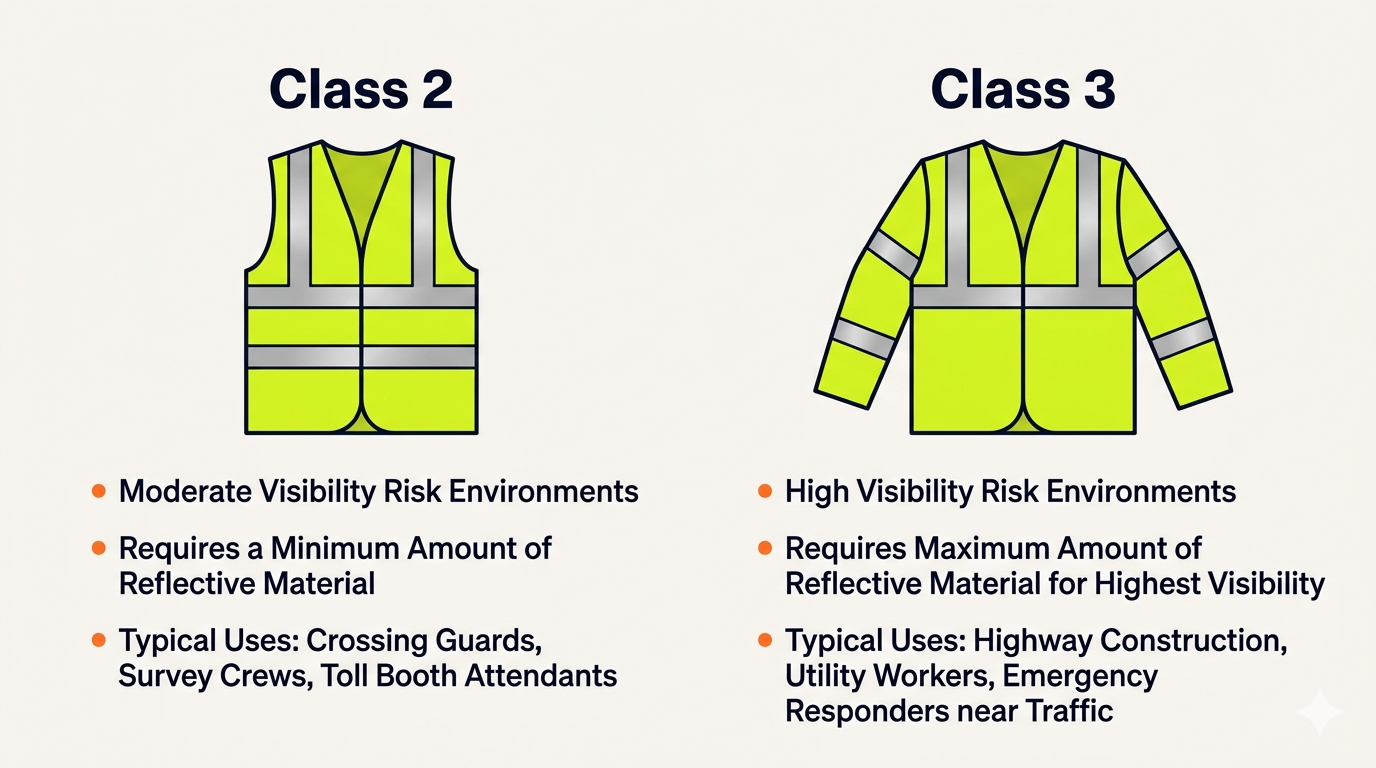
Class 2 vests require a minimum of 775 square inches of fluorescent background material and 201 square inches of retroreflective tape. The tape configuration is typically 2″ wide silver retroreflective at the chest level, mid-back, and around the torso. Sleeve tape is optional in Class 2.
The intent of Class 2 is to make a worker conspicuous against backgrounds of varying complexity at distances out to roughly 1,000 feet in daylight and 500 feet under headlight illumination. That’s adequate for most environments where vehicle traffic moves below 50 mph and where the worker is not the primary obstacle in the driver’s field of view.
Common Class 2 environments:
- Indoor warehouse and distribution operations with powered industrial trucks
- Construction sites away from active vehicle traffic
- Event marshaling and crowd management
- Indoor security
- Utility work on de-energized systems away from traffic
- Parking lot operations and valet
- Airport ramp operations (under specific FAA-approved configurations)
Class 3: The 1240-inch standard
Class 3 vests require a minimum of 1240 square inches of fluorescent background material — 60% more than Class 2 — and 310 square inches of retroreflective tape. The tape configuration is full 360° banding around the torso, banding at the shoulders, and sleeve tape that extends from the shoulder to the wrist. The sleeves are what most clearly distinguish a Class 3 vest from a Class 2 at a glance.
The intent of Class 3 is to make a worker conspicuous in environments where visibility is degraded — low light, bad weather, complex backgrounds with multiple obstacles, and any situation where vehicles approach at 50+ mph. The standard’s drafters explicitly cite the “complex” visual scene as the trigger for Class 3 rather than just speed.
Common Class 3 environments:
- All federal-aid highway work (per MUTCD §6D.03)
- State DOT road construction and maintenance
- Bridge work and tunnel work
- Nighttime road and construction work
- Emergency response (police, fire, EMS at incident scenes near traffic)
- Flagging operations directing 25+ mph traffic
- Transmission-line work in low-light corridors
- Tow truck and incident-management operations
The speed-and-environment decision
A simple framework most safety coordinators use:
| Worker exposed to… | Class |
|---|---|
| No vehicle traffic (indoor warehouse) | Class 2 |
| Vehicles under 25 mph | Class 2 |
| Vehicles 25–50 mph, daylight only | Class 2 |
| Vehicles 25–50 mph, low light or nighttime | Class 3 |
| Vehicles above 50 mph, any light | Class 3 |
| Federal-aid highway work, any conditions | Class 3 (MUTCD requirement) |
| Emergency scene management near traffic | Class 3 |
This is the floor. Some operators spec Class 3 across all crews even when Class 2 would suffice, because they don’t want supervisors making spec decisions on the fly. The cost premium is real (typically 15–25% per vest), but the operational simplicity has value.
Why the area calculation matters during decoration
This is the part most promotional vendors miss.
When you screen-print a 12″ wide × 5″ tall logo on the back of a Class 2 vest, you’re covering 60 square inches of background material. If the base vest only had 850 sq inches of background (just over the 775 minimum), the decorated vest now has 790 sq inches — still compliant. But add a 4″ × 6″ chest logo and you’re at 766 sq inches, which is below the Class 2 minimum.
The vest is now sold as “Class 2 ANSI 107 compliant” but in practice doesn’t meet the standard. In an OSHA walk-down or a citation review, this is the kind of detail that surfaces.
Reputable custom hi-vis manufacturers calculate the remaining background area after the proposed decoration is overlaid, and either approve the layout or propose alternatives that preserve compliance. Less-reputable vendors don’t, which is how customers end up with a thousand vests that technically don’t pass the standard.
When you’re getting a mockup, ask the vendor specifically: “What’s the remaining background area after this decoration?” If they can’t answer in square inches, find a different vendor.
Material and decoration choices that affect class compliance
A few less-obvious factors:
Mesh vs solid tricot: Both can be ANSI 107 compliant if the background color meets the chromaticity spec. Mesh is cooler and lighter. Tricot is more durable and provides a larger continuous background area for a given vest size. For Class 3, tricot is usually easier to spec because of the larger background requirement.
Decoration material chemistry: Screen-print plastisol ink doesn’t disqualify a vest from compliance as long as background area calculations work out. Heat-transfer vinyl is the same. But some heat-transfer films change the reflective performance of an underlying area — don’t print over reflective tape unless you’re using a vinyl rated for that application.
Wash cycles: ANSI 107 requires the vest to maintain performance through at least 25 home wash cycles. Industrial wash is harder on the garment. A vest that drops below background chromaticity spec after 30 industrial washes is technically out of compliance even though it looks fine. Plan replacement cycles accordingly.
Fluorescent color choice: Yellow-green and orange-red are both ANSI compliant. Yellow-green has the highest perceived visibility against asphalt (the most common road work background); orange-red is more visible against grass and tree-line backgrounds. Some state DOTs spec the color choice; most don’t.
What to ask your vendor
When you’re about to place an order, ask:
- What’s the base-vest background area, and what’s the remaining area after my proposed decoration?
- What’s the retroreflective tape spec — brand, candela rating, and ANSI configuration?
- Will you provide the ANSI/ISEA 107-2020 certificate with my order?
- What’s the expected service life in industrial wash conditions for my crew’s exposure profile?
- What’s the reorder lead time once artwork is on file?
If the vendor can answer all five without going to check, you’re probably in good hands.
Bottom line
Class 2 for most indoor work and lower-speed traffic exposure. Class 3 for federal-aid highway work, nighttime conditions, and any high-speed traffic exposure. Don’t let logo placement creep beyond the background-area threshold for your class. And buy from a vendor who can show you the area math on the mockup.
CTA: Get a free Class 2 and Class 3 mockup of your logo on each spec, so you can compare side-by-side. → /get-a-custom-quote
Win Free Stuff
Enter below for a chance to win plus receive 10% off your first order.
🎉 You are in!
Check your email for your 10% off code. Good luck!