Breakaway Hi Vis Vest vs Standard for Roadway Crews
Choosing a breakaway hi vis vest over a standard one is not a cosmetic decision, it is a decision about what happens in the two or three seconds after a vest snags on a moving vehicle, a piece of machinery, or a guardrail. A breakaway design is built with hook-and-loop or snap panels at the shoulders and sides that release under load, letting the garment separate from the wearer instead of dragging them along. This guide compares breakaway and standard construction across safety, durability, cost, and the specific roadway roles where the breakaway feature earns its keep.
How a Breakaway Vest Actually Works
Where a standard vest is stitched into one continuous piece of fabric, a breakaway vest uses reinforced hook-and-loop closures, or occasionally snap-away tabs, at the side seams and sometimes the shoulders. Under normal wear, those closures hold the vest together exactly like a standard garment. Under a sudden pull, typically an estimated 20 to 40 pounds of force depending on the manufacturer, the panels separate cleanly and the vest comes off the body rather than transmitting that force to the wearer.
Where Breakaway Vests Clearly Win
Release Safety Near Moving Traffic and Machinery
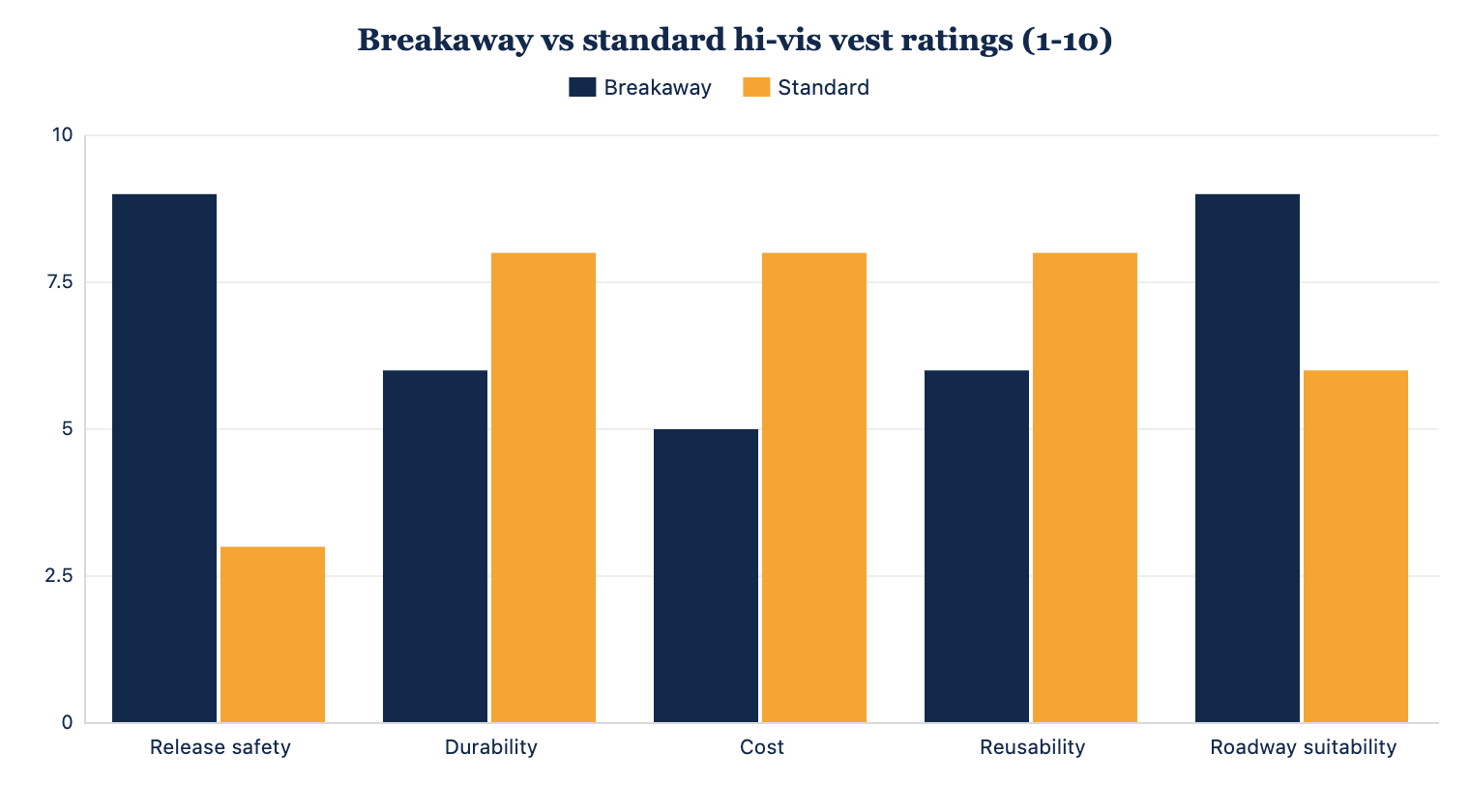
The entire point of a breakaway hi vis vest is entanglement protection, and it is the category where the design pulls furthest ahead of a standard vest. Flaggers working within arm’s reach of live traffic, tow operators around winches and cables, and anyone working near rotating equipment face a real risk of a vest catching on a mirror, a hook, or a machine guard. When that happens, a standard vest can drag a worker off their feet in an instant; a breakaway vest is designed to let go before that force reaches the body.
Roadway Suitability
Because roadway work concentrates exactly the hazards a breakaway design addresses, moving vehicles, tow cables, mirrors, and guardrails, breakaway construction rates highest for roadway suitability among the categories compared. It is not that a standard vest is unsafe everywhere; it is that roadway shoulders and active lanes are the specific setting where an entanglement risk is both plausible and severe.
Where Standard Vests Clearly Win
Durability and Everyday Wear
A standard, fully stitched vest simply lasts longer under the abuse of daily wear. The hook-and-loop closures on a breakaway design are a wear point; they lose grip strength after repeated washing and abrasion, and a worn closure can either release too easily during normal movement or fail to release when it matters. A standard vest has no equivalent failure point, which is why warehouse crews, general laborers, and indoor staff, who face little entanglement risk, tend to stick with standard construction.
Cost and Reusability
Breakaway hardware adds material and assembly cost, so a breakaway vest typically runs a modest premium over an equivalent standard vest at the same ANSI class. Reusability also favors standard vests slightly: once a breakaway vest actually releases on the job, the closures may need replacing or the vest may need retiring altogether, while a standard vest that survives a snag usually just needs inspection.
| Category | Breakaway | Standard |
|---|---|---|
| Release safety near hazards | Strong | Weak |
| Long-term durability | Moderate | Strong |
| Upfront cost | Higher | Lower |
| Reusability after an incident | Moderate | Strong |
| Fit for active roadway lanes | Strong | Moderate |
Which Crews Actually Need a Breakaway Design
Not every role needs the breakaway feature, and outfitting an entire warehouse staff with breakaway vests mostly adds cost without adding real protection. The roles that benefit most are the ones working closest to moving hazards on a regular basis.
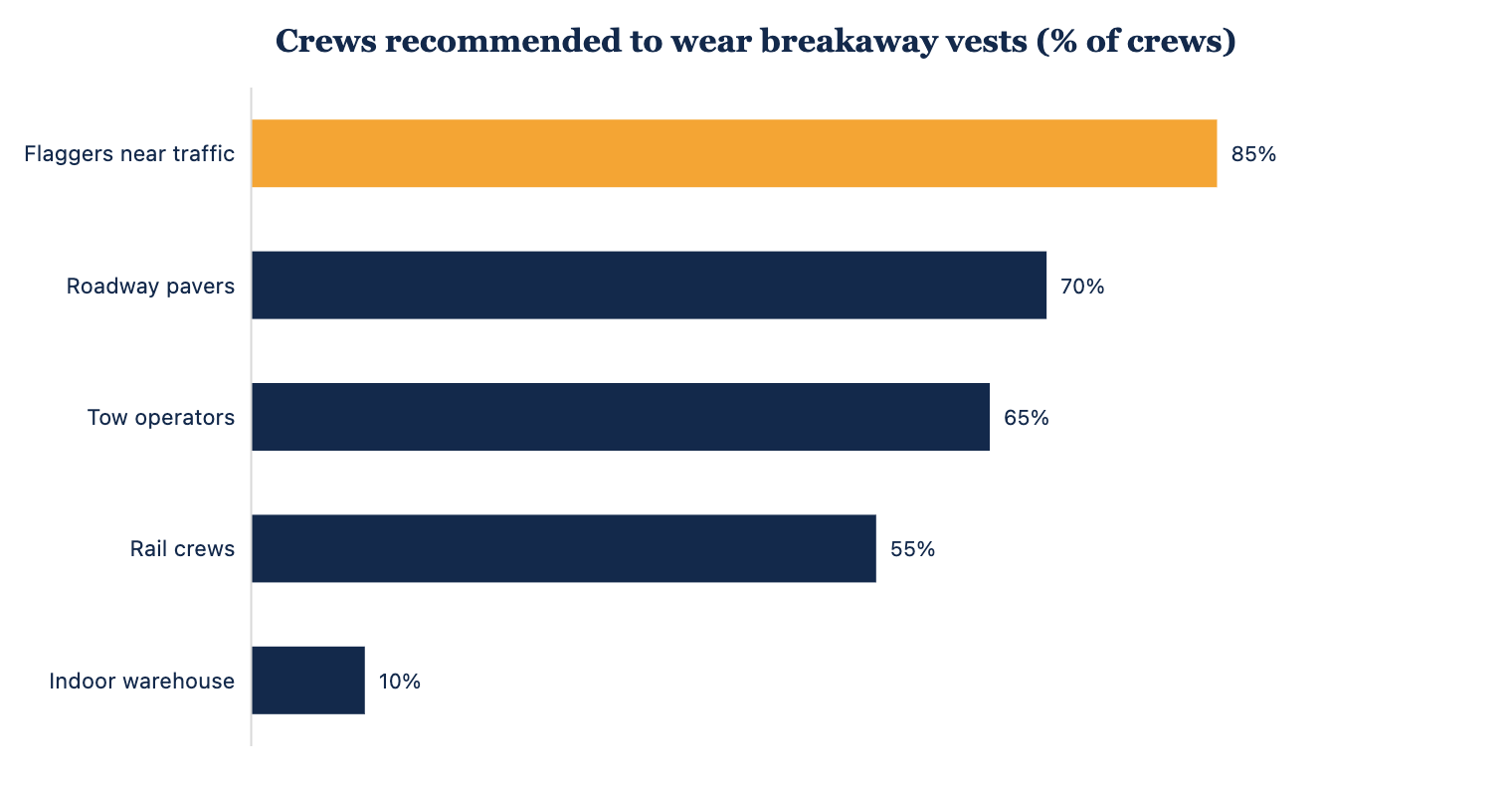
Flaggers working within a few feet of live traffic sit at the top of that list, followed closely by roadway pavers who work around slow-moving paving equipment with hoppers and augers that can catch loose fabric. Tow operators face a similar entanglement risk from winches and tow cables, and rail crews near moving rolling stock and coupling equipment fall into the same category. Indoor warehouse staff, by contrast, face very little entanglement risk from vehicles or machinery at walking speed, which is why breakaway adoption drops off sharply for that role.
Making the Call for Your Crew
Match the Feature to the Hazard, Not the Job Title
The best approach is to look at what a role actually stands next to during a shift rather than defaulting by job title alone. A flagger standing on a shoulder next to open traffic lanes has a very different entanglement exposure than an office-based supervisor who occasionally walks the same site, even though both might wear a breakaway hi vis vest under a blanket policy. Matching the feature to the specific hazard keeps the budget focused where it actually reduces risk.
Budgeting for a Mixed Fleet
Most roadway contractors end up running a mixed fleet: breakaway vests for flaggers, pavers, and tow crews, standard vests for everyone else. Because breakaway vests are a modest premium per unit rather than a dramatic one, outfitting the higher-risk roles first and expanding coverage over a season or two is a practical way to phase in the upgrade without a large one-time cost.
Inspecting and Maintaining Breakaway Hardware
Checking the Closures, Not Just the Fabric
A standard vest inspection mostly looks for torn fabric, faded fluorescence, and worn reflective tape. A breakaway vest needs one more check: the hook-and-loop or snap closures that make the release feature work in the first place. Grit, road dust, and repeated washing all reduce the grip strength of hook-and-loop panels over time, and a closure that has lost too much grip can either release under ordinary movement, which is annoying and can compromise the vest’s coverage mid-shift, or fail to release when a real snag happens, which defeats the entire purpose of the design. A quick monthly tug test on each closure panel is enough to catch hardware that needs replacing before it becomes a liability.
Setting a Realistic Replacement Cycle
Because closures wear faster than the surrounding fabric, most safety managers replace breakaway vests on a shorter cycle than standard vests, even when the fabric itself still looks serviceable. Treating the vest as job-site consumable rather than a one-time purchase keeps the release feature reliable and avoids the false confidence of a vest that looks fine but no longer releases as designed.
Bottom Line
A breakaway hi vis vest earns its cost premium specifically where entanglement risk is real: flaggers, pavers, tow operators, and rail crews working close to moving hazards. A standard vest remains the more durable, more reusable, and more affordable choice for everyone else. Match the feature to the hazard your crew actually faces, and a mixed fleet will outperform a one-size-fits-all policy every time.
Outfit Your Roadway Crew the Right Way
Tell us your roles and ANSI class requirements, and we will spec a mixed breakaway and standard order sized to your actual risk exposure.
Get a QuoteHome · About · Buying guides · Companion guide: hi-vis vest colors: lime vs orange
Win Free Stuff
Enter below for a chance to win plus receive 10% off your first order.
🎉 You are in!
Check your email for your 10% off code. Good luck!